“How are you going to get me clients?”
Here's the engine that does it.
That's the first question every consultant asks me, and it's the right one. Expertise doesn't sell itself. A buyer has to know you exist, trust what you do, and have a reason to talk this quarter.
For six months I'm your firm's go-to-market engine, sales and marketing both. We pick your buyers, build the target accounts, find the people who sign, write the messaging, run the outreach, track every conversation in a CRM, and work the proposals together. Built for consulting firms of one to five selling to businesses: the solo operator, the two-partner shop, the small team.
6 Months
Your go-to-market engine, built and run with you
Built in the first 60 days. Worked together for the rest.
5 Tracks
Named buyers inside every target account
The top of the house, the economic buyer, the owner of the problem, the board, and anyone who posts
1 CRM
Every account, every conversation, every next step
Reviewed with you every Monday morning
Solo to 5
One price for a firm of one, two, or five
One price for the whole partner group, whether that is one of you or five.
Two questions before we build anything. Who are you, and who buys from you?
Every piece of the engine is aimed. We aim it in week one.
You, and your firm
- You have 15+ years delivering results in one domain
- You are building a consulting or advisory firm that sells to businesses
- You are a solo operator, a two-partner shop, or a small team of up to five
- You are going independent, or already have a client or two and are tired of living on referrals
- You will take the meetings and deliver the work
Your ideal client profile (ICP), set in week one
- Size: The revenue band and headcount where your offer pays for itself
- Industry: The markets where your experience is already the proof
- Tech stack: The systems they run that you know from the inside
- Buying trigger: What just changed: a new leader, a new plant, an acquisition, a systems project
Three examples: an ERP specialist selling to $50M–$200M manufacturers already running Oracle. A supply chain operator selling to mid-market distributors that just made an acquisition. A finance leader selling to PE-backed companies in the first year after the deal. Same four filters, different answers.
The engine, step by step
This is the same motion I run for my own clients: find the accounts, find the people who sign, reach them directly, track every conversation. Built for your firm, run with you for six months.
Target accounts
An account-based marketing (ABM) list built in Sales Navigator against your ICP: every company that fits the size, the industry, the stack and the trigger. Not a spray list. A list you could defend account by account.
Your list follows your domain. A cloud specialist targets the AWS, Azure or Google Cloud customer base in the mid-market. An ERP specialist targets the Oracle or SAP install base. That is how we build the target accounts and run the chase.
Dymax, below, is one account off an example list: the Oracle install base.Account deep dive
A one-page brief on every priority account: what they make, what they run, what just changed, and where your offer fits. You walk into every conversation already knowing the business.
The Dymax brief below is the format.The people who sign
Five tracks into every account, named, linked and verified: the top of the house, the economic buyer, the owner of the problem, the board and investors, and anyone inside who posts. One contact is a hope. Five tracks is coverage.
Dymax's five tracks, with names and links, are below.The messaging
An opening message for each track, in your names, built on the account brief, then run as automated LinkedIn outreach built to book calls. The same setup I run for my own business. It grows your first-degree network with the right people while it works, and the goal is simple: you open your calendar on Monday morning and there are conversations on it. LinkedIn goes first, never alone: email and warm introductions run alongside it.
The Dymax opener is below, word for word.Your CRM and the dashboard
I build you a custom CRM as part of the buildout, like the Dymax example below. Every account, every conversation and every next step in one CRM. A Monday-morning pipeline view and a weekly scorecard: accounts worked, meetings, proposals, wins. We review it together every week and rebuild what is not working.
See the Dymax account in a sample CRM below.The pitch and the proposal
A discovery-call script, the pitch, and proposal and contract templates. Then live support on your first closes. The proposal is the same one-page format I use to sell this program.
The engine creates conversations. It does not guarantee clients, contracts or revenue. What you sign depends on your market, your offer and how consistently the outreach runs.
One real account, run through the engine
The example firm: an ERP consultancy whose suspect list is the Oracle install base. Swap in your domain and your market; the steps don't change. Here is one account off that list, built from public sources, the way every account gets built.
Account brief: Dymax Corporation
Steps 01–02- What they make
- Light-curable adhesives, coatings and curing equipment. Torrington, Connecticut. 500+ employees. Privately held, second generation, part of Bachmann Chemical & Engineering.
- What they run
- JD Edwards EnterpriseOne, consolidated from three separate JD Edwards systems (Germany, China, US) into one. Terillium case study
- What just changed
- An expanded site in Wiesbaden, Germany opened March 2026. A new distribution and technical center in Querétaro, Mexico opened July 2026. Five new senior leaders in 2025–26, and an open Global Controller seat asking for JD Edwards. Querétaro announcement
- Where the offer fits
- Two new sites on one ERP backbone, a finance team in transition, and a leader whose whole job is ERP governance. That is a buyer with a reason to talk this quarter.
The people who sign
Step 03Greg Bachmann, Director and Chairman
Chris Ciampi, Interim CFO: finance, treasury and tax
Ron Munnerlyn, Chief Transformation Officer: governance of the corporate ERP
Robert Palmer, Chief Business Officer: operations and commercial, worldwide
Beth Schivley, Chief Experience Officer: Global IT
Track 4, board and investors: Dymax is privately held with no outside investors, so this track folds into track 1. Track 5, engagement: anyone at Dymax who posts. You comment on their posts before you ever send a message.
The opener, to the owner of the problem
Step 04Ron, congratulations on the Chief Transformation Officer role.
Dymax opened Wiesbaden and Querétaro inside four months, on a JD Edwards backbone that was already consolidated from three systems into one. That is the stretch where ERP governance either scales with the business or leaks into spreadsheets.
We have spent our careers inside Oracle ERP programs. Worth 20 minutes to compare notes on what we have seen work at companies your size?
Illustrative. Written for this page, not sent.
The account in your CRM
Step 05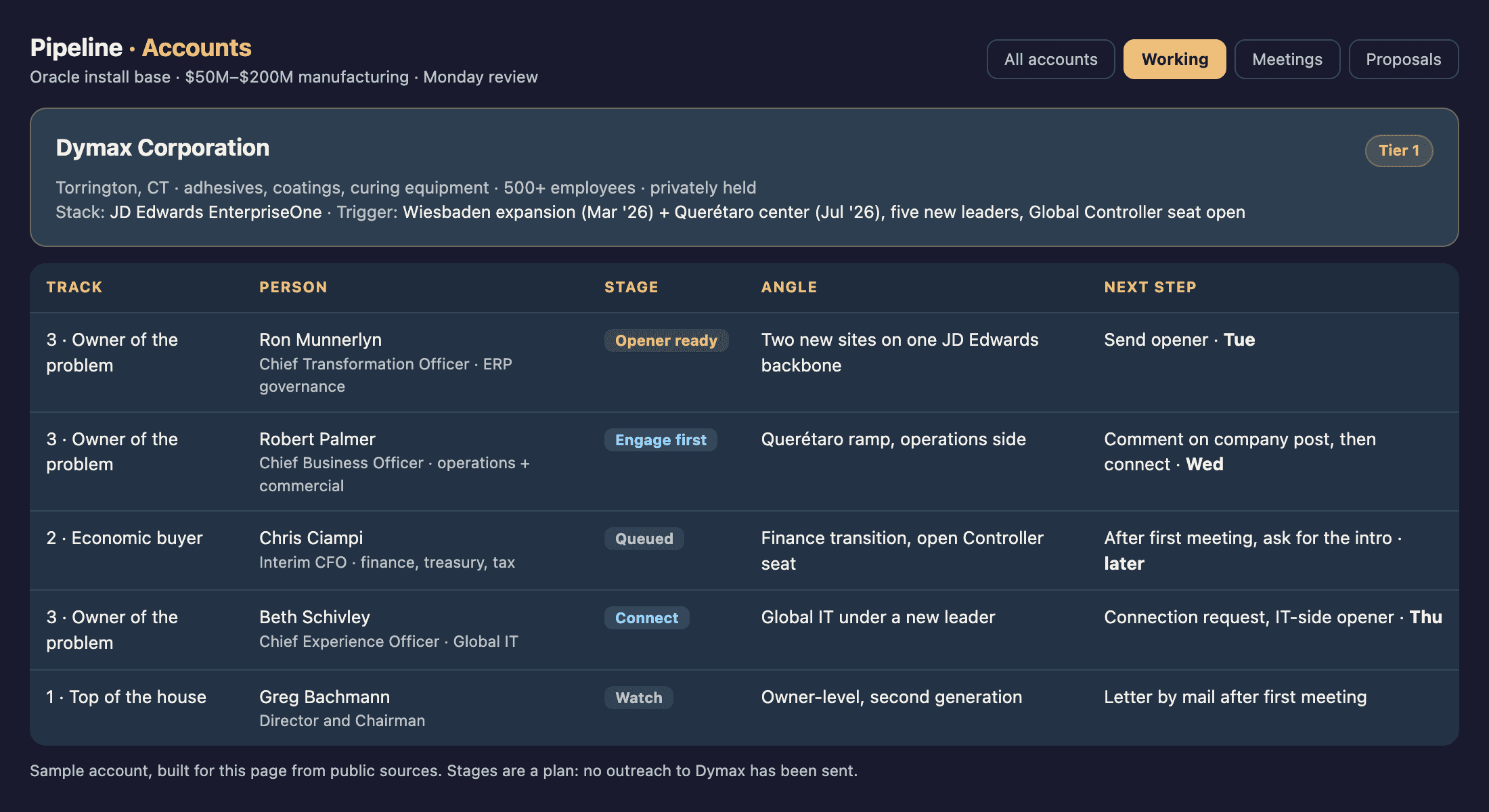
A custom CRM like this is part of the buildout: I build it for your firm, and every account on your list gets a row like this one. Every Monday we open the pipeline and decide who moves next.
What buyers see when they check you out
Every message you send makes a buyer look you up. The foundation is what they find. We build it in the first 60 days, alongside the engine.
The toolkit
Your firm's identity kit: the same toolkit my coaching clients get, rebuilt for a company instead of a candidate. Name, positioning, the one-line offer, and the words every other piece reuses.
Company bio
One page on who the firm is, what you and your people have delivered, and for whom. It's the page a buyer forwards to the CFO before your first call.
Company service page
Your offer on one page: the buyer, the problem, the engagement shape and what the first 90 days look like. Every outreach message points here.
Company website
Built for search and for AI engines like ChatGPT and Perplexity (SEO, AEO, GEO), so the buyer who looks you up finds a firm, not two résumés.
talentguy.io is built the same way →Portfolio and LinkedIn Featured
Your profile, and your partner's if you have one, rewritten for the buyer, not a recruiter. The Featured sections carry your use cases, your service page, and a 30-60-90 plan for a target account as one of the pieces.
Use case examples
The problems you have solved, written the way the buyer would describe them, with the before, the work and the result. They're the proof a buyer checks before replying.
Funnels, landing pages and lead magnets
Something worth giving away to your market, a page that captures who takes it, and the follow-up that turns a download into a conversation.
One of mine: the AI Compute Funding Index →The operating checklist
Every customer-facing part of the firm, mapped and tracked. Plus AIOS™: 20+ AI skills set up to run practice development for your business. Specialized services, such as intellectual property registration, are scoped and quoted separately, only if you want them.
Customer acquisition
The engine above, written down so it runs the same way every week
Delivery
How an engagement starts, runs and closes out
Client support
What the client hears from you, and when
Contracts
Templates for your own attorney to finish
Proposals
The one-page format, the pricing logic, the follow-up
Six months, in order
Kickoff. Your ICP, your offer and your first market agreed. Access and assets requested.
Build: target accounts and briefs, the people who sign, the messaging, the LinkedIn automation, your CRM, the foundation pages, your first lead magnet, the operating checklist.
Run: outreach live, pipeline reviewed every week, what is not working rebuilt, proposals and first closes worked together.
What each of us does
What this is not
- —Not a recruiter, and not a job search
- —Not a percentage of your revenue, and not paid per meeting
- —Not a guarantee of clients, contracts or revenue
- —Not legal, tax or accounting advice
- —Not a course. The engine is built with you, for your firm
Investment
$15,500
1 kickoff + 18 sessions · 6 months · one price for the whole firm
One price whether you are one partner or five. Split two ways, it's $7,750 each. Three ways, about $5,170. Five ways, $3,100.
Payment plan available: $7,500 at signing · $4,000 in month 2 · $4,000 in month 3
What's Included:
- 1 kickoff + 18 working sessions with Bill over six months, for every partner in the firm
- Positioning and service offer design for your specific domain and your specific buyer
- Your commercial engine: a verified target list from Sales Navigator research, a one-page brief on every account, and outreach sequences sent in your name
- Automated LinkedIn outreach built to book calls, the same setup I run for my own business, aimed at the companies you are built to serve and growing your first-degree network as it runs
- Your marketing engine: company website, portfolio pages, business use cases in your LinkedIn Featured section, funnels, landing pages and lead magnets
- A Monday-morning pipeline dashboard and weekly scorecard: accounts worked, meetings, proposals, wins
- A market-presence audit: what buyers, and AI search tools like ChatGPT and Perplexity, find when they look you up
- Your operating checklist, covering every customer-facing part of the business: customer acquisition, delivery, client support, contracts and proposals
- Proposal and contract templates, pitch scripts, and live support on your first closes
- LinkedIn repositioning for every partner: profile, headline, Featured section and content strategy, with the website built for search and AI engines (SEO, AEO, GEO)
- Newsletter setup and a blog strategy built to get you cited, not just ranked
- AIOS™: 20+ AI skills running your practice development while you focus on clients
The Commitment
I build the engine with you and work it alongside you for six months. You bring the expertise and have the conversations; I build and run the machinery that puts you in front of the right buyers. Specialized services, such as intellectual property registration, are scoped and quoted separately, only if you need them.
45 minutes · No pressure · We'll see if this is the right fit
Common Questions
I've never sold consulting services before. Can I actually do this?
Most of the people who go through this program have never sold independently. The program covers the full sales process — how to position your offer, how to approach the right buyers, how to run a discovery call, and how to close. You're not cold calling. You're having strategic conversations with decision makers about problems you've spent 20 years solving.
How is this different from the Accelerator coaching tier?
The Accelerator coaching tier is built around a job search. This is built around a business. For six months I act as your commercial engine, sales and marketing: I build the target list, the automated outreach, the website and portfolio pages, the funnels and the lead magnets, and the operating checklist behind every customer-facing part of the practice. If you are still weighing a senior role against going independent, start with the coaching tiers.
We are three or five partners. Does the price change?
No. It is one price for the firm, whether you are one partner or five. Every partner attends the working sessions, every partner's LinkedIn profile is rewritten for the buyer, and the engine is built for the firm, not for one person. Split five ways, that is $3,100 each. The only exception is a much larger organization, which we scope separately.
What about contracts, intellectual property and the rest of the back office?
The operating checklist covers every customer-facing part of the business, from acquisition to support, with proposal and contract templates included. Specialized services, such as registering intellectual property, are scoped and quoted separately, and only if you need them. None of this is legal advice; for that you will still want your own attorney.
How long does it take?
Six months. The first 60 days build the engine: positioning, the target list, the funnels and pages, the checklist. Months three through six we run it together, adjust what is not working, and work the pipeline through proposals and first closes. How fast clients sign depends on your market and on how consistently the outreach runs.
What kind of domain expertise is right for this?
Any deep operational expertise in a specific domain — supply chain, finance, revenue operations, HR transformation, cloud architecture, enterprise sales, field service operations, and more. The requirement is that you've spent 15+ years delivering measurable outcomes in your field and can clearly articulate the problem you solve for a specific type of company.
What if I already have a client or two?
Even better. We'll build the pipeline, the positioning and the marketing infrastructure so you stop relying on referrals alone.
Frequently Asked Questions
What does an AI-augmented fractional consultant actually do?
They sell their domain expertise to several companies on a fractional basis, but they deliver it through an AI operating system that compresses what used to take an entire team into work one person can ship. The expertise stays human — judgment, relationships, knowing what actually matters — and the execution gets augmented. That's how a single experienced operator now competes with a firm.
What is a Domain Translator?
A Domain Translator is a senior professional who takes 20 years of expertise in a specific domain — finance, security, product, operations — and translates it into the language of AI systems, directing AI to do the work they used to do by hand in a fraction of the time. It's one of the three tracks in the post-W-2 economy, alongside AI Orchestrators and Systems Builders. The domain knowledge is the moat; AI fluency is the multiplier.
What is an AI Orchestrator?
An AI Orchestrator is a professional who directs a team of AI agents the way they once directed a team of people. Instead of doing the analysis, the research, and the production themselves, they combine senior domain judgment with AI fluency to coordinate AI systems and deliver consulting-grade outcomes roughly ten times faster than the traditional approach.
I'm scared to leave the security of my W-2 for fractional work. How do I make that leap?
That fear is rational, but be honest about what just happened: the 'security' of a W-2 is the thing your layoff took away in a single meeting. Fractional work spreads your income across several clients instead of betting everything on one employer who can cut you without warning. You don't jump blind — you build the positioning, the pipeline, and the first conversations before you ever need them, so the practice is already moving when you go.
You know who you are. Let's see if we're the right fit.
This is right for you if:
- You are building a firm that sells to businesses: solo, with a partner, or a small team
- You have 15+ years of domain expertise in a specific field
- You're targeting real companies with real budgets — not startup gigs
- You're ready to do the outreach and close the business
What we cover on the call
- Your domain expertise and how to package it as a specific, sellable offer
- Your ICP: the size, industry, stack and trigger that fit your offer
- The first accounts we would target, and who inside them signs
- Whether the AI Fractional Accelerator is the right fit for where you are
45 minutes · No pressure · We'll see if this model makes sense for you
Disclaimer: TalentGuy.io does not warrant or guarantee specific income, client acquisition, or business results. Individual results will vary based on experience, effort, market conditions, and other factors outside our control. Testimonials and examples shared on this page reflect individual experiences and are not a guarantee of results. This program is educational and coaching in nature and does not constitute legal, financial, or professional licensing advice.
Two ways to start.
Book a call and I'll have your Opportunity Map and Executive SWOT built before we sit down. Not ready to talk? Get the AI Compute Funding Index — 500+ funded companies, tracked by domain, stage, and backer.